Logo
Logo
  • About
    • Previous
    • About
    • About GRI
    • Resilience Overview
    • Team
  • Resources
    • Previous
    • Resources
    • Resilience News
    • Publications
    • Upcoming Events
    • Resilience Projects
  • Resilience Programs
    • Previous
    • Resilience Programs
    • Global Resilience Research Network
    • Resilience Champions
    • Corporate Partnerships
    • Seed Grant Program
  • Resilience Education
    • Previous
    • Resilience Education
    • Resilience Courses
    • Degree Programs
  • Contact
  • LinkedIn

Resilience News

  • GRI Core Projects
  • Publications
  • Resilience News
  • Stephen Flynn
  • A–Z
  • Z–A
  • Newest First
  • Oldest First
  • Architecture
  • Award
  • Barbados
  • Behavioral Health
  • Black Sea
  • Book Launch
  • caribbean
  • Chief Technology Officer
  • Climate change
  • Coastal Infrastructure
  • Coastal Resilience
  • Community
  • Community Resilience
  • COVID-19
  • Critical Infrastructure
  • Cyber Resilience
  • Cybersecurity
  • designs
  • Distinguished Senior Fellow
  • Dominica
  • Ecology
  • Economic Resilience
  • Educational Resilience
  • Emergency response
  • Energy
  • Enterprise
  • Enterprise Resilience
  • Environmental Resilience
  • Event Recap
  • Faculty Affiliate
  • Food Crisis
  • global resilience
  • GrainCrisis
  • GRI Whitepaper Series
  • Healthcare
  • Hurricane Season
  • Individual Resilience
  • Internet Resilience
  • island nations
  • Massachusetts
  • Nada Sanders
  • nantucket
  • Odesa
  • Organizational Resilience
  • Partners
  • Policy and practice
  • Project: Creating a resilient Internet of Things (IoT)
  • Project: Critical Infrastructure Network (CInet)
  • Research
  • Resilience
  • Russia
  • Social Resilience
  • Societal Resilience
  • Solution: Critical Infrastructure Resilience
  • Solution: Cyber Resilience
  • Solution: Incident Management & Business Continuity and Recovery
  • Solution: Integrated Resilience Action Planning for Enterprises
  • Solution: Integrated Resilience Enhancement Solution
  • Solution: Supply Chain
  • Solution: Vetted Technology Resilience
  • Stephen Flynn
  • Supply Chain
  • Sustainability
  • Technology
  • Terrorism
  • Transportation
  • Ukraine
  • Urban Development
  • USAID
  • Vaccination

Adm. Peter Neffenger visits Northeastern’s Marine Science Center, for cross-institute tour

Representatives from two Northeastern University institutes dedicated to sustainability and resilience welcomed Admiral Peter Neffenger (USCG Ret.), to the Marine Science Center in Nahant. Admiral Neffenger, a Distinguished Senior Fellow at the Global Resilience Institute (GRI) and the former Administrator of the Transportation Security Administration (TSA), was briefed on Northeastern’s Coastal Sustainability Institute (CSI) and on the research efforts underway in the Nahant labs.

Powerful earthquake hits China’s Sichuan region for the second time in a decade

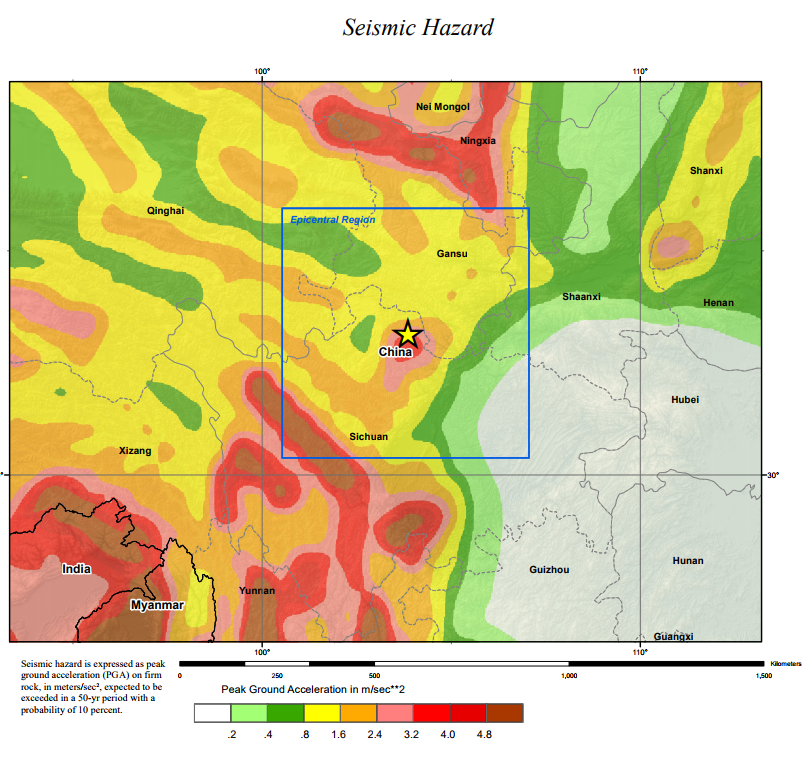
On the evening of August 8, 2017, an earthquake shook the mountainous region of northwest Sichuan, China. A popular tourist destination in China, the Jiuzhaigou nature reserve receives 5 million visitors per year; just days before the earthquake they welcomed 41,000 people. Two weeks after the quake, there are still conflicting reports on the size and magnitude of this earthquake. The US Geological Survey (USGS) reported the earthquake was measured at a 6.5 magnitude, west southwest from the epicenter in Yongle. Whereas Xinhua, a Chinese news agency, announced the earthquake hit a 7.0 magnitude, citing the China Earthquake Networks Center as their source.
Newspaper printer

Grant program connecting fields of research at Northeastern, funding resilience projects – News@Northeastern

Eleven interdisciplinary resilience research projects tackling a wide array of critical resilience issues are currently being funded by the Global Resilience Institute (GRI) at Northeastern University. The cross-college teams are engaging in a unique interdisciplinary effort involving an array of resilience-related topics. On August 14, News@Northeastern featured the program.

NOAA: 2017 Atlantic hurricane season ‘could be the most active since 2010’

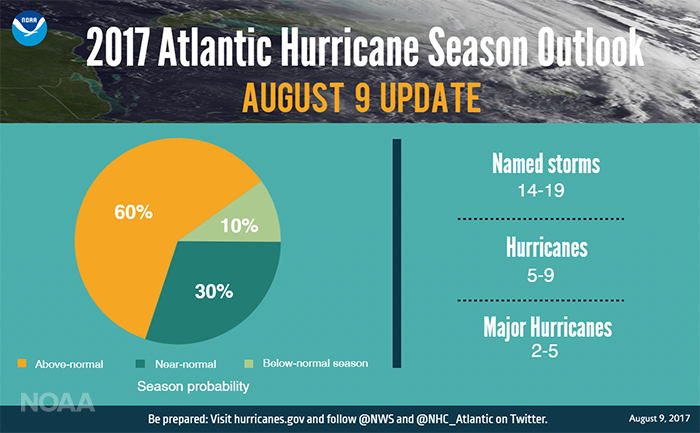
The 2017 Atlantic hurricane season has the potential to be “extremely active,” and could be the most active season seen since 2010, the National Oceanic and Atmospheric Administration (NOAA) announced on Wednesday. The updated 2017 hurricane season outlook now predicts a 60% chance of an above-normal season after forecasters increased the anticipated number of major hurricanes and named storms.

Pacific Northwest endures historic heat wave while smoke from B.C. wildfires pollutes the region

The Pacific Northwest region of the United States is in the midst of a heat wave that has come close to breaking previous temperature records. In the past 123 years, triple-digit temperatures have only been recorded on three days in Seattle -- and though the city remained below triple digits last week, the high reached 94 degrees, hitting a daily record. Meanwhile, Portland experienced even higher temperatures, reaching a high of 105 degrees on Thursday. This was just shy of the warmest temperature ever recorded in Portland, which was 107 degrees.

Wildfires in southwestern U.S. blaze a path for flooding in their wake

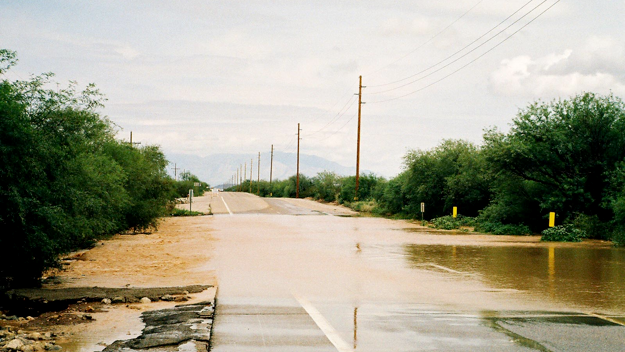
Several southwestern states have been ravaged by 18 wildfires in past weeks, the products of drought and extreme heat that dried out vegetation and increased the speed at which the fires spread.  However, as the rainy season approaches, some communities find themselves struggling instead with the recent onset of extreme rainfall. The widespread and severe storms, coupled with the conditions left behind in fire-damaged areas, have resulted in flash floods.

Evaluating the R4 rural resilience initiative Q1 report

On July 20th, Oxfam America (OA) and the United Nations World Food Programme (WFP) released the R4 Rural Resilience Initiative report for the first quarter of 2017. R4 is a joint undertaking between the two organizations, designed in 2011 as a response to increased climate volatility and its malignant effect on rural agriculture. The term "R4" refers to a combination of four strategies aimed at increasing resilience in food insecure communities: “risk reduction”, including implementation of Food Assistance for Assets (FFA) programs and development of resilient infrastructure, “risk transfer” through insurance and training, as well as “prudent risk taking” in the form of microcredit and diversification of livelihoods, and “risk reserves” or savings.

British Columbia’s wildfire impact on lumber supply to the U.S.

This summer, roughly 375 wildfires in British Columbia burned through 913,000 acres of Canada’s forestry region, forcing area residents to…

Increasing the sustainability and resilience of coastal communities by improving tide gate operation

Improving the operation of tide gates to better protect people and ecosystems is the focus of a three-year project recently funded by the National Science Foundation (NSF).

Local mariners conduct evacuation as wildfire burns in Sicily

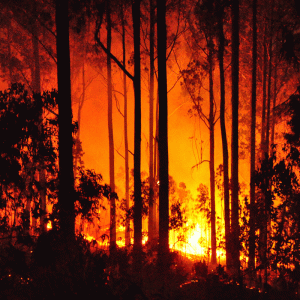
In the remote resort village of Calampiso, located on the northwestern coast of Sicily, a July wildfire has forced around 700 tourists to evacuate. Given the remote location of Calampiso, combined with the position of the fire, evacuees had no choice but to flee by boat.

Resilience experts join GRI as Distinguished Senior Fellows

The Global Resilience Institute (GRI) at Northeastern University looks forward to drawing on the extensive expertise of four recently appointed…

Boston Mayor: ‘A truly resilient city is one that works to achieve equity’

Boston’s first strategy for advancing resilience and racial equity across the city, Resilient Boston: An equitable and connected city, was unveiled by Mayor Marty Walsh.
  • Previous
  • 72
  • 73
  • 74
  • 75
  • 76(current)
  • 77
  • 78
  • 79
  • 80
  • Next